
On-chain trading used to mean spot swaps: you connected a wallet, swapped tokens in a liquidity pool, and moved on. It was simple, composable, and permissionless but it wasn’t a complete market. Most serious trading activity in any asset class isn’t just buying and holding; it’s expressing risk efficiently. Traders hedge portfolios, take leveraged views, short overvalued assets, run market-neutral strategies, and manage exposure dynamically as volatility changes. For years, those behaviors remained concentrated on centralized exchanges because DeFi simply couldn’t provide the same combination of leverage, execution quality, and risk tooling.
That is changing fast. Decentralized perpetual exchanges often shortened to "perp DEXs" are no longer an experimental corner of DeFi. They are becoming the place where the most important decisions about price, leverage, and risk are made. As liquidity deepens and infrastructure improves, perps are evolving from a product category into market plumbing: the layer that other on-chain systems route around and depend on. In the same way that spot DEXs became core rails for token discovery and permissionless exchange, perp DEXs are now becoming the rails for risk transfer, hedging, and price formation at scale.
This shift isn’t happening because spot markets became less relevant. Spot still matters for onboarding into assets, for long-tail tokens, and for fundamental ownership. But perps are winning the "center of gravity" because they concentrate what traders care about most: capital efficiency, continuous liquidity, and the ability to express both bullish and bearish views without operational friction.
Perps win because they’re the most efficient way to trade risk
Perpetual futures are a trading primitive designed for convenience and leverage. Unlike dated futures contracts, perps don’t expire. Instead, they use a funding mechanism to keep the perp price anchored to a reference index over time. That design offers two powerful benefits: traders don’t need to roll contracts, and the market can remain continuously liquid around the most traded assets.
On-chain, these properties matter even more. DeFi is naturally fragmented across chains and applications. Every extra step bridging, borrowing, swapping, rehypothecating—adds friction, slippage, and execution risk. Perps compress many of those steps into one place. With a perp position, a trader can:
take directional exposure with less upfront capital than spot,
short an asset without complicated borrowing routes,
hedge a spot portfolio without selling the underlying,
run delta-neutral or basis-style strategies with far fewer moving parts.
Capital efficiency is not just a “nice-to-have.” It’s a structural advantage that changes how markets behave. When traders can express risk efficiently, they trade more actively, market makers quote tighter spreads, and liquidity deepens. That deep liquidity then becomes self-reinforcing: it attracts more strategies, which attracts more liquidity, which improves execution. Over time, the perp venue becomes the default marketplace where the marginal trader expresses their view—and marginal traders often determine price.
Funding rates turn perp DEXs into information engines
One reason perp DEXs are becoming infrastructure is that they don’t just facilitate trades; they produce public, actionable signals. The most important is the funding rate. In traditional markets, many of the most valuable signals positioning, leverage demand, liquidation risk are private or delayed. On-chain, those signals can be surfaced more transparently.
Funding rates tell you whether long leverage is crowded or short leverage is crowded. They reflect the cost of holding a position and reveal how aggressively one side of the market is paying to stay in the trade. When funding is persistently positive, it often indicates strong demand to be long with leverage. When it’s negative, it can signal heavy shorting or defensive positioning. Combined with open interest and liquidation data, funding becomes a real-time measure of market sentiment and leverage pressure.
Once these signals are available on-chain, other protocols can build on them. Lending markets can incorporate leverage demand into risk parameters. Vaults can choose when to deploy capital into basis or carry strategies. Structured products can dynamically hedge. In effect, the perp DEX becomes a data-rich control panel for the rest of DeFi—a public market layer that other systems can read and respond to.
Perp DEXs are closing the “CEX execution gap” with specialized infrastructure
For a long time, the biggest blocker to on-chain perps was performance. Traders could accept some extra friction for spot swaps; perps are less forgiving. Perp markets need fast matching, predictable execution, robust liquidation pipelines, and reliable oracle systems. If latency is high or order execution is inconsistent, professional flow will not stick.
The most important development of the last few years is not just more volume it’s architectural evolution. Perp DEXs increasingly build around execution rather than bolting execution onto generic constraints. This shows up in several forms:
Orderbook models optimized for on-chain constraints.
Some leading perp DEXs have implemented orderbooks that feel closer to centralized venues, with tighter spreads, more granular order types, and better control over entry and exit. This is especially appealing for active traders and market makers who need predictable microstructure.
Purpose-built settlement domains.
Instead of deploying perps as just another smart contract, some teams have moved toward dedicated execution environments—high-throughput L2s, appchains, or specialized chains designed around trading performance. The motivation is simple: if you want exchange-grade markets, you can’t treat the exchange as a normal dApp. You need deterministic throughput, stable fees, and infrastructure that prioritizes matching and settlement.
Better liquidation engineering.
Liquidations are the true test of a perp system. When volatility spikes, positions that were safe minutes ago can become undercollateralized. The venue has to unwind risk quickly, fairly, and predictably. Mature perp DEXs invest heavily in liquidation mechanisms, backstop liquidity, and insurance models that limit bad debt while minimizing destructive cascades.
This infrastructure work matters because it changes who participates. Retail can trade on almost anything; professional flow requires reliability. As on-chain perps get more reliable, they attract more sophisticated strategies, which in turn deepens liquidity and makes the market more robust for everyone.
Perps are becoming the liquidity hub that everything routes around
Infrastructure becomes “core” when other systems depend on it. In DeFi, spot DEXs became core because they were the easiest place to exchange assets and bootstrap liquidity. Perp DEXs are becoming core because they are where leverage and hedging concentrate—and those are the flows that shape the entire market.
When a perp venue becomes liquid, it turns into the primary hedging destination. Market makers hedge inventory risk there. LPs hedge exposure there. Traders who hold spot positions hedge downside there. Even protocols that are not “trading apps” end up interacting with perps indirectly because perps influence price formation and volatility transmission.
This creates a powerful network effect:
Traders go where liquidity is deepest.
Liquidity deepens where traders go.
Market makers quote tighter where they can hedge efficiently.
The venue with the tightest, most reliable markets becomes the default.
Once that happens, other products route around the perp DEX like a highway interchange. Aggregators integrate it. Vaults build on it. Lending protocols respond to its signals. Portfolio tools track it. The perp DEX stops being “a destination” and becomes “a layer.”
Composability is turning perp DEXs into risk primitives, not isolated exchanges
DeFi’s advantage has always been composability—the idea that protocols can plug into each other without permission. Early perp DEXs weren’t deeply composable in practice because execution was inconsistent and risk models were too immature for other systems to safely depend on. As perps mature, composability is increasing, and with it, the sense that perps are becoming infrastructure.
A mature decentralized perpetual exchange doesn’t just offer trading. It offers a margin system. It offers a liquidation engine. It offers a stable set of market signals. These are reusable components. When a vault wants to run a delta-neutral strategy, it needs a reliable place to short. When a yield product wants to hedge exposure, it needs a reliable place to offset risk. When a lending market wants to model liquidation risk, it needs a reliable picture of leverage conditions. Perp DEXs increasingly provide all of that.
This is also where cross-margin matters. Cross-margin systems allow collateral to support multiple positions and, in some designs, multiple products. That increases capital efficiency for traders and makes the venue feel more like a prime brokerage layer rather than a simple trading UI. As cross-margin designs mature, perp DEXs become not just marketplaces but capital coordination systems—places where users park collateral and use it dynamically across risk.
Cross-chain UX is turning perp DEXs into the “account layer” for on-chain trading
A major obstacle to DeFi adoption has always been cross-chain friction. Users hold assets across networks, but trading and collateral often live in one place. Bridging is operationally annoying and carries risk. In 2026, leading perp DEXs are increasingly competing on an abstraction layer: making cross-chain feel like one account.
The idea is simple: users should not need to think about where their collateral lives. They should be able to deposit from the chain they’re on, trade where liquidity is best, and withdraw to where they want to use funds next. Under the hood, the platform might use bridging, messaging, or canonical stablecoin transfer paths, but the user experiences it as a single venue with a single balance.
This is infrastructure-level behavior. Historically, centralized exchanges became the “account layer” that absorbed fragmentation: users sent funds from wherever and traded in one place. Perp DEXs are now trying to achieve a version of that convenience without custodial control—keeping settlement transparent and user ownership intact while hiding interoperability complexity. If they succeed, perp DEXs won’t just be markets; they’ll be the primary interface to cross-chain trading and leverage.
Transparency and verifiability make on-chain perps “public market infrastructure”
Perp DEXs are also becoming foundational because they operate in public. Even when execution involves specialized designs, the broader system is more inspectable than a centralized exchange. This creates two important effects.
First, transparency increases trust—especially during stress. Traders can see activity, funding conditions, and (depending on the venue) open interest and liquidation dynamics. In the long run, trust is not built by marketing; it’s built by surviving volatility and being predictable in failure modes.
Second, transparency improves ecosystem learning. Researchers, traders, and developers can analyze what works. They can compare liquidation outcomes across models. They can see how incentive programs affect volume quality. They can observe how liquidity migrates. This feedback loop accelerates innovation: good designs propagate, bad designs get punished by the market, and the overall quality of on-chain market infrastructure improves.
In traditional finance, the best market data is often expensive, proprietary, or delayed. On-chain, many of the most useful signals can become widely accessible. That makes perp DEXs not just trading venues but shared informational infrastructure for the entire ecosystem.
What “core infrastructure” means in 2026: the perp stack as a platform
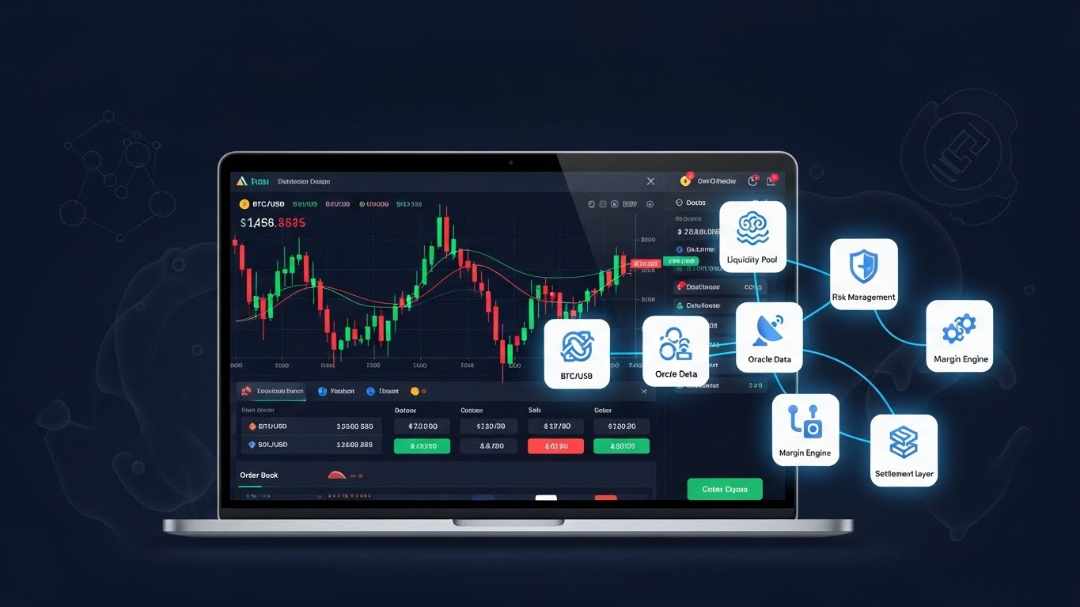
To understand why perp DEXs are becoming core, it helps to stop thinking of them as single applications and start thinking of them as stacks. A mature perp stack increasingly includes:
A performant execution layer.
Whether it’s an L2, appchain, or specialized chain, the venue needs throughput and deterministic execution suitable for derivatives trading.
A risk engine designed for stress.
Margin requirements, liquidation thresholds, insurance/backstop mechanisms, and collateral haircuts are the heart of the system. A perp DEX is only as good as its ability to remain solvent.
Oracle and market integrity systems.
Perps rely on indices and reference prices. Integrity systems—redundant pricing inputs, manipulation resistance, and robust funding calculations—are essential.
Cross-chain account abstraction.
Users increasingly expect a unified trading experience across networks. The best venues will handle complexity without compromising safety.
Integration surfaces for composability.
APIs, vault integrations, and standardized interfaces allow other protocols to build on the venue, turning it from a destination into a layer.
Once these pieces exist, the perp DEX becomes something like an operating system for trading: other applications sit on top, route through it, hedge via it, and price risk using its signals.
Conclusion
Perpetual DEXs are becoming the core infrastructure of on-chain trading because they solve the most important financial problem in any market: efficient risk transfer. They allow traders to express views with leverage, hedge portfolios without selling underlying assets, and access deep liquidity in a format that is always on and operationally simple. As these venues scale, they become the default location where leverage demand, funding costs, and positioning pressure are discovered, turning them into the primary hubs of price formation and volatility transmission.
Just as importantly, the rise of perp DEXs is being driven by infrastructure maturation, not just hype. Better execution environments, stronger liquidation engineering, more sophisticated risk engines, and cross-chain user experiences are transforming perps from “DeFi products” into reliable market layers other protocols can build around. In 2026, you can debate which platform leads at any given moment, but the deeper structural reality is becoming clear: decentralized perpetual exchanges are evolving into the backbone of on-chain markets, and the rest of DeFi is increasingly organizing itself around them.















Write a comment ...