
As we enter 2026, the decentralized finance (DeFi) landscape has transitioned from an era of speculative experimentation to one of institutional-grade utility. For years, the industry grappled with the "DEX Trilemma"—the seemingly impossible task of achieving centralized exchange (CEX) speeds without compromising the decentralized security and self-custody that define the blockchain ethos. Today, a new architectural standard has emerged. The 2026 DEX Blueprint represents a sophisticated convergence of Layer-3 (L3) appchains, Zero-Knowledge (ZK) proofs, and intent-centric design, creating a financial ecosystem that is as fast as a trading floor and as secure as a vault.
For a Defi Exchange Development Company, the challenge is no longer just about writing smart contracts; it is about engineering complex, multi-layered systems that satisfy the performance demands of high-frequency traders while meeting the rigorous compliance and security standards of global financial institutions.
The Modular Paradigm: Scaling Through L3 AppChains
The most significant shift in Decentralized Exchange Development over the last year has been the move away from general-purpose Layer-1 networks toward application-specific environments. In 2026, high-performance DEXs are predominantly built on Layer-3 (L3) AppChains or "Hyperchains."
Unlike traditional DEXs that compete for block space with NFTs, games, and social apps, an L3 AppChain is a dedicated execution layer that settles on a Layer-2 (L2), which in turn settles on a secure Layer-1 like Ethereum. This vertical integration allows for unprecedented throughput, with modern platforms frequently exceeding $10,000$ transactions per second (TPS). By isolating the exchange’s logic into its own chain, developers can optimize the virtual machine specifically for order matching and settlement, eliminating the "noisy neighbor" effect that previously led to gas spikes and transaction failures.
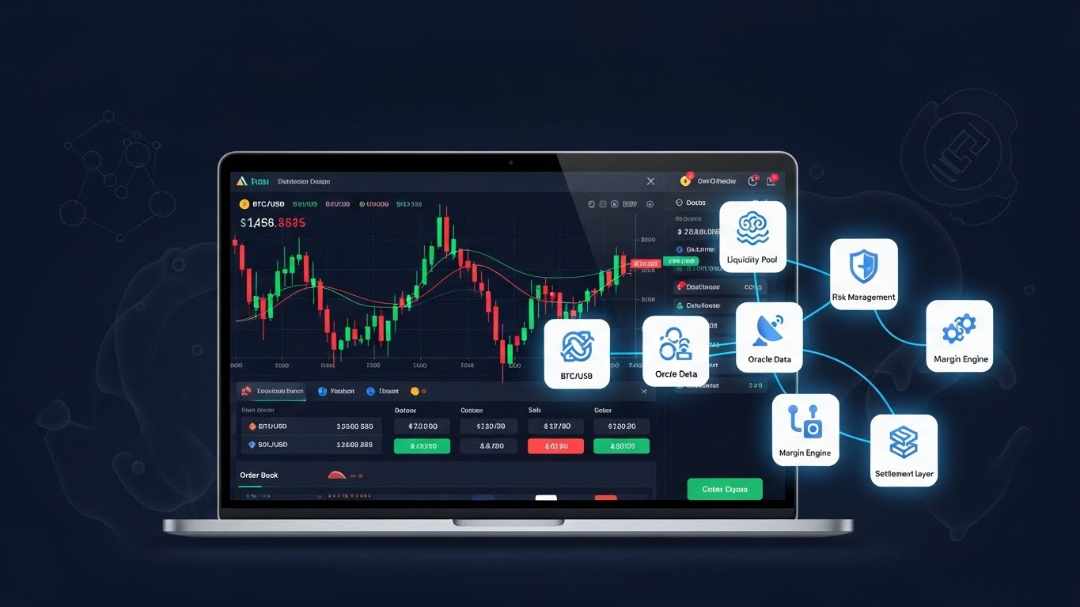
Furthermore, these appchains enable "Enshrined Liquidity." In this model, the exchange is not just an application sitting on top of the chain; the chain is the exchange. This allows for sub-millisecond latency in order matching, as the consensus mechanism itself is tuned for the specific needs of a high-frequency trading venue.
Cryptographic Certainty: The Maturity of ZK-Infrastructure
While speed is achieved through modularity, security is maintained through the mass adoption of Zero-Knowledge (ZK) Rollups. In 2026, ZK-technology has moved from a complex research topic to the "standard operating system" for Decentralized finance exchange security.
ZK-Rollups provide a mathematical guarantee of transaction validity. Every trade executed on an L3 is bundled into a batch, and a succinct cryptographic proof (a SNARK or STARK) is generated. This proof is sent to the parent chain, which can verify the entire batch of thousands of trades in a single operation. This creates a "Trustless Finality" where the exchange operator cannot cheat or lose funds; the math simply wouldn't allow a fraudulent state transition to be accepted.
For Decentralized Exchange Software Development Services, this provides a dual benefit:
Instant Withdrawals: Unlike older optimistic rollups that required a 7-day "fraud-proof" window, ZK-based DEXs allow users to move assets back to the mainnet almost instantly once the proof is verified.
Privacy-Preserving Compliance: ZK-proofs allow users to prove they are compliant with regulations (like MiCA in Europe or the GENIUS Act in the US) without revealing their private wallet history or identity to the public, solving the long-standing tension between privacy and regulation.
The Shift to Intent-Centric Trading and AI Solvers
The 2026 blueprint also marks the end of the "manual trade" era. Traditional Automated Market Makers (AMMs) forced users to navigate slippage, gas prices, and network switching. Modern Defi Exchange Development has replaced this with Intent-Centric Design.
In an intent-centric DEX, the user does not submit a transaction; they submit a "signed intent" (e.g., "I want to exchange 10 ETH for at least 35,000 USDC"). A network of professional AI Solvers then competes to find the most efficient path to fulfill that intent. These solvers can tap into hybrid liquidity merging on-chain order books, AMM pools, and even off-chain market makers to provide the user with the best possible price.
"The user experience has shifted from 'How do I do this?' to 'This is what I want.' The underlying complexity of bridges, gas, and liquidity routing is now completely abstracted by AI-driven infrastructure." — Industry Insight, 2026 FinTech Report
This abstraction layer is vital for institutional adoption. A corporate treasurer or a hedge fund manager doesn't want to manage private keys across six different L2s; they want a unified execution interface that feels like a Bloomberg Terminal but operates on decentralized rails.
Institutional-Grade Security and "Programmable Trust"
As the value locked in decentralized venues hits new record highs in 2026, the "Security-First" approach of a Defi Exchange Development Company has evolved beyond simple audits. We have entered the age of Continuous Security and Multi-MPC Custody.
Modern DEXs now integrate:
Real-Time On-Chain Monitoring: Automated "circuit breakers" that can pause specific pools or contracts if anomalous behavior—such as an exploit or a sudden liquidity drain—is detected by AI-driven security bots.
Multi-Party Computation (MPC) Wallets: The industry has moved away from single-seed phrases to MPC-based "Social Recovery" and institutional custody. This ensures that even if one key is compromised, the user's assets remain secure through a distributed shard system.
Proof-of-Solvency 2.0: High-speed DEXs now provide real-time, ZK-based proofs of their reserves. Users no longer have to wait for monthly audits; they can verify that the exchange is fully collateralized every few seconds directly on their dashboard.
Global Compliance: The "Sovereign-by-Design" DEX
Perhaps the most impressive feat of the 2026 DEX Blueprint is its ability to handle global regulation. As jurisdictions like the EU (MiCA), Singapore, and the UAE have finalized their frameworks, a successful Decentralized finance exchange must be "Compliance-Native."
This is achieved through Permissioned Hooks. While the core protocol remain permissionless and decentralized, specific pools—such as those trading tokenized Real-World Assets (RWAs)—can have "Compliance Hooks" attached. These hooks automatically verify a user's ZK-KYC credential before allowing them to enter the pool. This allows a single DEX to serve both the "degen" crypto-native community and the highly regulated institutional market on the same underlying infrastructure.
Conclusion
The 2026 DEX Blueprint has proven that the "Trade-off Era" is over. Through the strategic use of Decentralized Exchange Software Development Services that prioritize L3 modularity, ZK-security, and intent-based UX, we have created a financial system that is more resilient, transparent, and efficient than the centralized models it sought to improve.
As we move toward 2027, the focus is shifting from building the exchange to integrating it into the daily fabric of global commerce. Whether it is a bank settling a tokenized bond or a consumer buying a cup of coffee via a stablecoin rail, the decentralized exchange is now the invisible engine powering the global economy.












Write a comment ...