
The decentralized finance (DeFi) landscape in 2026 is no longer the "wild west" of experimental protocols and speculative frenzy. It has matured into a sophisticated, $2 trillion ecosystem where the infrastructure is as robust as the traditional systems it seeks to replace. At the heart of this evolution is the explosion of the on-chain derivatives market. As centralized giants face increasing regulatory scrutiny and transparency demands, the spotlight has shifted to the Perpetual Futures Trading DEX Platform.
For founders, fintech entrepreneurs, and institutional players, the question is no longer whether to enter the space, but how to do so with enough speed and technical sophistication to compete with market leaders. Building a perpetual dex platform like hyperliquid is a monumental task, but the emergence of the White Label Perpetual DEX Solution has fundamentally changed the barrier to entry. This article explores the strategic, technical, and market-driven components required to build the next dominant force in DeFi.
The Exponential Rise of On-Chain Derivatives
In 2025, the DEX-to-CEX perpetual futures volume ratio tripled, reaching nearly 20% of the total global market. This shift was not accidental; it was driven by a "narrowing efficiency gap." Historically, professional traders stayed on centralized exchanges (CEXs) because on-chain latency was too high and liquidity was too thin. However, the advent of high-performance Layer-2s and app-chains has leveled the playing field.
A Perpetual Futures Trading DEX Platform today offers what was previously thought impossible: sub-millisecond execution speeds paired with the absolute security of self-custody. Users are increasingly wary of "black box" centralized platforms where their collateral is commingled. In a decentralized environment, every liquidation, every funding rate payment, and every trade is verifiable on-chain. This transparency is the cornerstone of the next big thing in DeFi.
The Founder’s Dilemma: Build from Scratch vs. White Label
When a team decides to launch a Perpetual Futures Trading DEX Platform, they face a critical choice: commit to 18 months of intensive R&D or utilize a White Label Perpetual DEX Platform.
The Hidden Costs of Custom Development
Building a high-performance engine from the ground up involves more than just writing smart contracts. It requires:
The Matching Engine: Developing a non-deterministic, low-latency off-chain matching engine that settles on-chain is a feat of distributed systems engineering.
The Risk Engine: A flawed liquidation algorithm can lead to protocol insolvency during high volatility.
Security Audits: In 2026, a single audit is insufficient. Professional platforms require continuous formal verification and multi-stage audits, which can cost upwards of $200,000 before a single user even signs on.
The Strategic Advantage of White Label Solutions
A White Label Perpetual DEX Solution allows founders to bypass these technical hurdles. By using a White Label Perp DEX Launcher platform, an entrepreneur can deploy a battle-tested architecture that has already processed billions in volume. This shifts the focus from "how do we make the trade execute?" to "how do we acquire and retain users?"
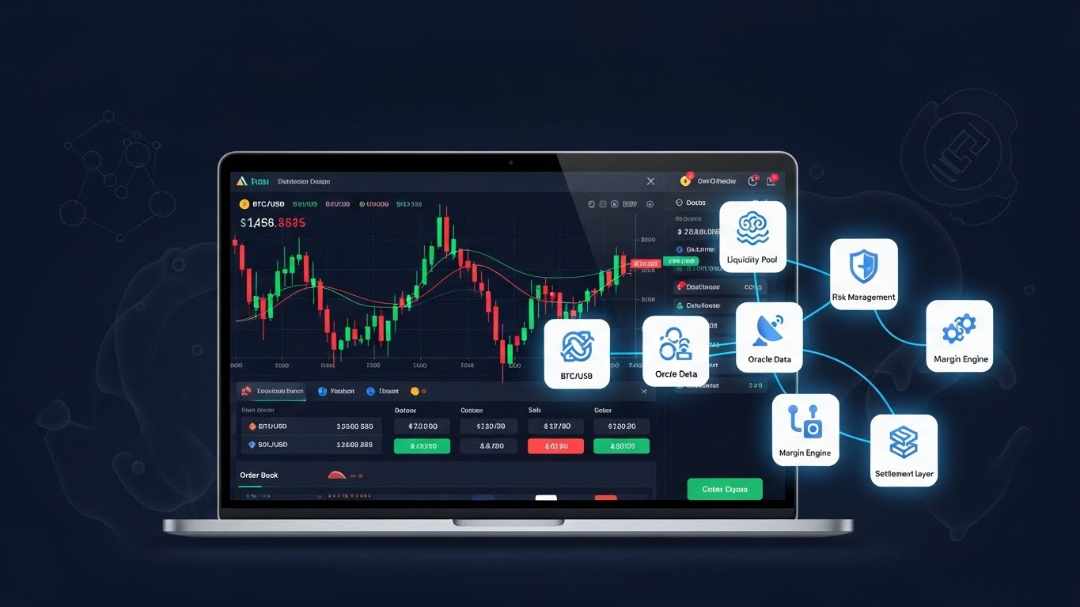
A White Label Perpetual Exchange Platform provides the "guts" of the exchange—liquidity aggregation, risk management, and the matching engine while allowing for complete UI/UX customization. This is the same "Lego-block" philosophy that allowed fintech to explode in the 2010s, now applied to the complex world of on-chain derivatives.
Technical Pillars of a "Hyperliquid-Style" Platform
If you aim to build a perpetual dex platform like hyperliquid, your architecture must excel in three non-negotiable areas: performance, liquidity, and risk mitigation.
1. High-Performance Infrastructure
The modern trader expects an experience indistinguishable from a CEX. This is achieved through a hybrid architecture. The "state" of the trades—balances, positions, and collateral—resides on-chain, but the high-frequency matching occurs in an optimized off-chain environment or a specialized "app-chain." White Label Perpetual DEX Platform Development today often utilizes "Stack" technologies (like Arbitrum Orbit or OP Stack) to give the exchange its own dedicated execution environment, preventing gas spikes on the mainnet from affecting trade execution.
2. Deep, Programmable Liquidity
A trading platform without liquidity is a ghost town. Successful platforms utilize a combination of:
vAMMs (Virtual Automated Market Makers): Allowing for high leverage without needing a 1:1 liquidity provider for every pair.
Liquidity Vaults: Similar to GMX’s GLP or ApolloX’s ALP, these vaults allow users to act as the "house," earning fees while providing the necessary depth for large trades.
Institutional Integrations: A Perpetual Futures Trading DEX Platform Solution must support API connectivity for professional market makers who provide the "tight spreads" retail users demand.
3. The Oracle and Risk Layer
In perpetual trading, the "Price" is everything. The platform must integrate with low-latency oracles like Pyth or Chainlink to prevent "toxic flow" and oracle manipulation. The White label perpetual dex platform development process includes building robust circuit breakers that pause liquidations if price feeds become desynchronized, protecting both the user and the protocol's insurance fund.
Institutional Alignment and the 2026 Regulatory Landscape
The "Next Big Thing" in DeFi must be built with an eye toward institutional capital. In 2026, clarity is the new gold. With frameworks like MiCA in Europe and clearer SEC guidelines in the US, institutions are no longer afraid of DeFi; they are looking for the right "rail" to enter.
A White Label Perpetual Futures Trading DEX Platform that includes built-in compliance modules—such as geo-blocking, wallet screening (AML/KYC), and institutional-grade reporting—is far more likely to succeed than a purely "anonymous" protocol. Institutions demand a environment where they know their counterparty isn't a sanctioned entity, but they still want the efficiency of a DEX.
The winners in this cycle are the platforms that make these capabilities "invisible." Users enjoy the speed and self-custody of a DEX, while the backend handles the complex compliance requirements necessary for sustained, legal growth.
Conclusion:
Building the next big thing in DeFi requires a blend of visionary marketing and industrial-grade technology. While the dream is to create a perpetual dex platform like hyperliquid, the reality is that the market moves too fast for slow, custom-build cycles.
By leveraging a White Label Perpetual DEX Solution, you are not just buying software; you are acquiring a shortcut to the most lucrative sector in decentralized finance. Whether you are a startup looking to disrupt the status quo or an established firm looking to expand your product line, the tools are now available to launch a Perpetual Futures Trading DEX Platform that is secure, scalable, and ready for the trillion-dollar future of on-chain finance.



















Write a comment ...