
The decentralized finance (DeFi) landscape has entered a phase where infrastructure maturity matters as much as innovation. While early DeFi growth was driven by experimentation and greenfield protocol development, today’s market increasingly rewards speed, reliability, and capital efficiency. Nowhere is this shift more evident than in decentralized derivatives, where perpetual futures trading has emerged as the dominant use case by volume, user engagement, and revenue potential.
Launching a perpetual decentralized exchange (DEX) has traditionally required deep expertise across smart contract engineering, risk modeling, oracle design, and high-performance trading systems. For many businesses, this technical burden creates a significant barrier to entry. As a result, White Label Perpetual DEX platforms have become a strategic alternative—enabling teams to deploy sophisticated perpetual futures exchanges without building the entire stack from scratch.
This article explores how and why white label perpetual DEX solutions are reshaping market entry strategies, the business and technical advantages they offer, and what organizations should consider when choosing a white label approach over custom development.
The Maturation of Perpetual DEX Infrastructure
Perpetual futures contracts now account for the majority of crypto derivatives trading, often exceeding spot market volume by multiples. In decentralized markets, perpetual DEXs regularly process billions of dollars in monthly volume, driven by demand for leverage, hedging, and capital-efficient exposure to digital assets.
Early decentralized derivatives platforms faced significant limitations—thin liquidity, slow execution, and fragile risk systems. Over time, these weaknesses have been addressed through improved oracle design, more sophisticated margin engines, layer-2 scaling, and hybrid trading models. Today’s Perpetual Futures Trading DEX Platform solutions rival centralized exchanges in functionality while preserving non-custodial settlement and on-chain transparency.
This technical maturity has shifted the competitive question. Instead of whether decentralized perpetual trading works, the focus is now on who can deploy, scale, and differentiate fastest. White label platforms directly address this challenge.
Why Building a Perpetual DEX From Scratch Is Increasingly Impractical
Launching a perpetual DEX is fundamentally different from deploying a spot exchange or AMM. A production-grade perpetual platform must handle leverage, liquidations, funding rates, insurance funds, and extreme market volatility—all in real time.
Custom development introduces several major constraints:
High Development Cost and Time
Designing and testing core perpetual infrastructure often takes 12–24 months with a specialized engineering team. During this time, market conditions, user preferences, and competitor positioning can change dramatically.
Complex Risk Engineering
Liquidation logic, margin requirements, and oracle dependencies must be precisely calibrated. Even minor flaws can lead to insolvency events or cascading liquidations, as seen in several early DeFi protocol failures.
Security and Audit Overhead
Perpetual DEX smart contracts require multiple audit rounds and ongoing monitoring. The cost of security alone can consume a significant portion of a startup’s budget.
These realities have made full custom builds less attractive—especially for businesses whose core value lies in distribution, liquidity partnerships, or financial strategy rather than protocol engineering.
Understanding the White Label Perpetual DEX Model
A White Label Perpetual DEX Platform provides a ready-to-deploy perpetual trading infrastructure that can be customized, branded, and configured for specific markets or user segments. Rather than licensing a centralized backend, operators deploy smart contracts and front-end systems that they control while benefiting from pre-built architecture.
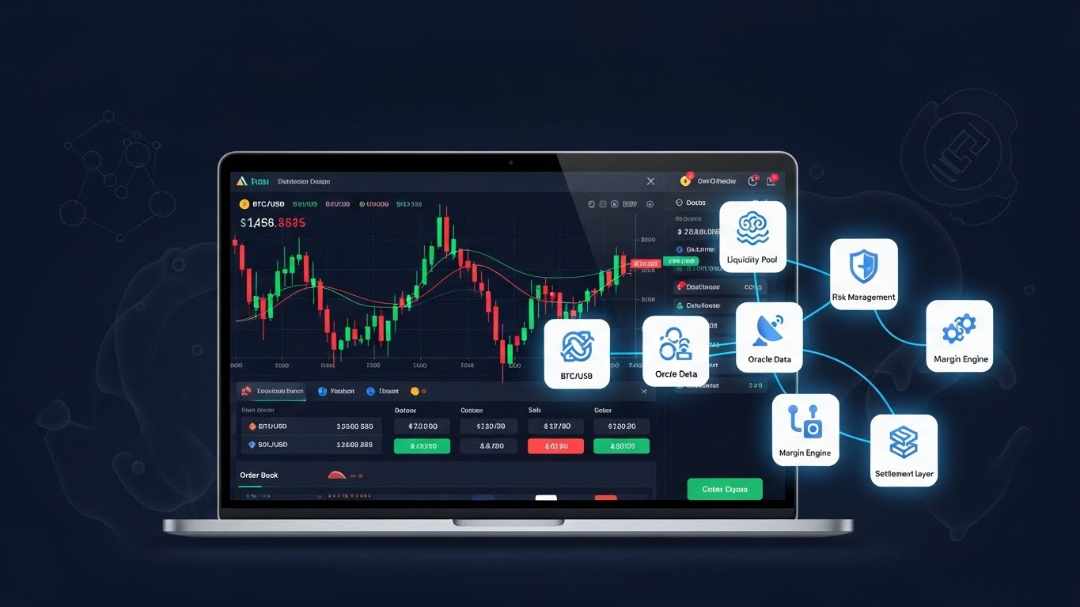
A typical White Label Perpetual DEX Solution includes:
Pre-audited perpetual trading smart contracts
Margin, liquidation, and funding rate engines
Oracle integrations for accurate pricing
Liquidity models (AMM, oracle-based, or order book)
Front-end interfaces and wallet connectivity
Admin dashboards for risk parameters and analytics
This model allows teams to focus on go-to-market execution, user acquisition, and ecosystem growth instead of foundational engineering.
Speed to Market as a Strategic Advantage
In DeFi, liquidity and user attention are highly reflexive. Platforms that launch earlier can bootstrap liquidity more effectively, establish brand recognition, and attract integrators before competitors emerge.
A White Label Perp DEX Launcher Platform dramatically compresses launch timelines. Instead of spending months validating core mechanics, teams can deploy, test with real users, and iterate rapidly. This speed enables operators to:
Capture early liquidity in emerging asset categories
Align launches with favorable market cycles
Respond quickly to new narratives such as RWAs, AI tokens, or L2 ecosystems
In contrast, teams pursuing full custom builds often miss optimal market windows due to prolonged development cycles.
Economic Efficiency and Capital Allocation
From a financial perspective, white label deployment shifts costs from fixed engineering investment to variable operational scaling. This is particularly attractive for startups and enterprises seeking predictable capital expenditure.
With White Label Perpetual DEX Platform Development, resources can be reallocated toward:
Liquidity incentives and market making
Community building and governance design
Partnerships with wallets, bridges, and aggregators
Compliance strategy and legal structuring
This reallocation often produces higher returns than incremental protocol optimizations that users may never notice.
Core Technical Strengths of White Label Platforms
Proven Trading and Liquidity Architecture
Modern White Label Perpetual Exchange Platforms support multiple liquidity models. Some leverage virtual AMMs optimized for capital efficiency, while others implement hybrid or on-chain order books to attract professional traders.
Crucially, these architectures have been tested under real market stress, including high-volatility events and extreme funding rate swings. This operational history reduces the likelihood of catastrophic failure during volatile market conditions.
Robust Risk and Liquidation Engines
Risk management is the defining feature of any perpetual platform. White label solutions embed dynamic margin requirements, automated liquidations, and insurance fund mechanisms that adjust to market volatility.
These systems are often refined across multiple deployments, benefiting from real-world data rather than theoretical modeling alone. For operators, this shared learning curve is one of the most compelling advantages of white label perpetual dex platform development.
Oracle Redundancy and Price Integrity
Accurate pricing underpins all perpetual trading. Leading white label platforms integrate multiple oracle sources and safeguards to prevent manipulation during low-liquidity periods. This redundancy is costly to design independently but critical for long-term platform credibility.
Revenue Models Enabled by White Label Perpetual DEXs
Perpetual DEXs are among the most monetizable DeFi primitives. A White Label Perpetual Futures Trading DEX Platform enables flexible revenue strategies without modifying core protocol logic.
Common revenue streams include:
Trading fees tiered by volume or leverage
Funding rate spreads captured by the protocol
Liquidation penalties and insurance fund allocations
Premium analytics or API access for institutions
Some operators layer token-based incentives on top, using governance tokens to align traders, liquidity providers, and long-term stakeholders.
Real-World Deployment Scenarios
White label perpetual platforms are increasingly used across diverse organizational models:
Crypto-Native Startups
Teams launch niche perpetual DEXs focused on specific assets or trading strategies, using white label infrastructure to validate demand quickly.
Centralized Exchanges Expanding On-Chain
Several exchanges deploy decentralized perpetual platforms to hedge regulatory risk while maintaining user access to derivatives.
Layer-2 and Ecosystem Builders
Networks deploy native perpetual DEXs to drive on-chain volume, fee generation, and ecosystem stickiness.
These use cases demonstrate that white label platforms are not shortcuts—they are strategic deployment tools.
Customization Without Reinvention
A common misconception is that white label platforms limit differentiation. In practice, White Label Perpetual DEX Platform Development emphasizes modularity. Operators can customize:
Supported assets and leverage limits
Fee structures and incentive models
Governance frameworks
Front-end UX and branding
This balance between standardization and customization allows teams to innovate at the product and ecosystem level without destabilizing core mechanics.
Regulatory and Operational Flexibility
While DeFi operates differently from centralized finance, regulatory awareness remains essential. White label platforms allow operators to design front-end access controls, jurisdictional interfaces, and governance structures that align with their legal strategy.
Non-custodial settlement and protocol-level decentralization reduce certain compliance burdens while preserving optionality for future adaptation—an increasingly valuable trait as global crypto regulation evolves.
Long-Term Scalability and Future Readiness
As DeFi infrastructure evolves, perpetual DEXs will increasingly integrate with rollups, cross-chain liquidity networks, and institutional-grade analytics. White label platforms are typically designed with upgrade paths that accommodate these developments.
By adopting a Perpetual Futures Trading DEX Platform Solution today, operators position themselves to scale alongside advances in execution speed, capital efficiency, and composability—without repeated rebuild cycles.
Conclusion
The era of building every DeFi protocol from scratch is giving way to a more pragmatic, infrastructure-first mindset. For perpetual trading, where complexity and risk are inherently high, white label platforms offer a compelling balance of speed, safety, and strategic control.
A White Label Perpetual DEX Platform allows businesses to enter one of DeFi’s most lucrative markets without bearing unnecessary technical and financial risk. By leveraging proven architecture while focusing on differentiation and growth, operators can compete effectively in a rapidly evolving derivatives landscape.



















Write a comment ...